
Screed specification
A screed specification states the construction (bonded, unbonded or floating), the depth, the material and its strength class under I.S. EN 13813, the surface regularity class, and the joints. The the BS 8204 summary of BS 8204 gives the sand and cement depths: 25 mm bonded (40 specified), 50 mm unbonded (70 specified), and 75 mm floating (65 mm in housing).
Proprietary screeds set their own minimumss, which are thinner: a floating calcium sulphate screed can be 35 mm in a house.
Free, no obligation. One local screeding contractor prices it, not five.
Depths by construction
| Construction | Sand and cement | Calcium sulphate | Cement liquid (cement-based liquid screed / cement-based liquid screed) |
|---|---|---|---|
| Bonded | 25 mm min, 40 mm specified | 25 mm | Not given / 20 mm |
| Unbonded | 50 mm min, 70 mm specified | 30 mm | 50 mm / 30 mm |
| Floating, housing | 65 mm | 35 mm | 45 mm / 35 mm |
| Floating, other buildings | 75 mm | 40 mm | 60 mm / 40 mm |
| Over heating pipes | Within the floating depth | 25 mm cover | 25 mm / 25 mm cover |
On each: bonded screeds have the least risk of cracking, curling and hollowness and suit heavy-duty use and rigid floorings, on a base prepared mechanically for bond. Unbonded screeds go where bond isn't possible (a contaminated base, or a DPM on top) and are likely to curl at joints, cracks and edges.
Strength classes under I.S. EN 13813
I.S. EN 13813:2002, the Irish edition of the European standard from NSAI, classes screeds by compressive (C) and flexural (F) strength in N/mm²: C5 to C80 and F1 to F50, of which the lower ones apply to levelling and the higher to wearing screeds. Liquid screeds on the Irish market run from CT-C20-F4 and C25-F5 for cement-based to over C30-F8 for the strongest calcium sulphate. BS 8204-1 accepts a C20 or C25 screed as meeting its in-situ crushing requirements, and that ready-mixed screeds should meet BS EN 13813.
Mixes for site-made sand and cement
BS 8204-1 recommends a cement to fine aggregate ratio of 1:4 by weight, no richer than 1:3 and no leaner than 1:4.5. Fine concrete screeds, with aggregate up to 10 mm, run 1:4 to 1:5. Cure under polythene for at least 5 days. The mixer must be a forced-action mixer: a free-fall mixer won't do for a fast-drying mix.
Surface regularity
| Class | Most deviation under a 2 m straightedge | Typical |
|---|---|---|
| SR1 | 3 mm | Cement-based liquid screed: easily SR1 |
| SR2 | 5 mm | Calcium sulphate: SR2 |
| SR3 | 10 mm |
Reinforcement: fibre or mesh
A floating sand and cement screed needs D49 mesh or fibres, and so does an unbonded one; a calcium sulphate screed needs none. A cement-based liquid screed shrinks very little: under 400 microns a metre. Whether a sand and cement screed takes mesh or fibres is a specification choice: write it into the spec so every price includes the same thing.
A specification checklist
- Construction and minimum depth, and the levels it's set to.
- Material: product name, or mix and aggregate for site-made.
- Strength class (e.g. CT-C20-F4).
- Surface regularity class.
- Reinforcement: mesh, fibres or none.
- Bays and joints, including over every structural joint and between heating zones.
- Curing and protection.
- Drying target before flooring (usually 75% RH) and who tests.
- Underfloor heating commissioning, if any.
Screed laid by the contractor who takes your call
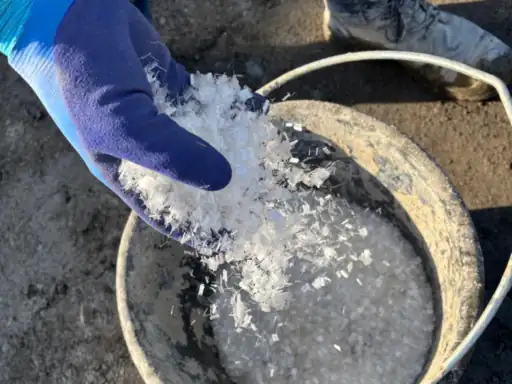
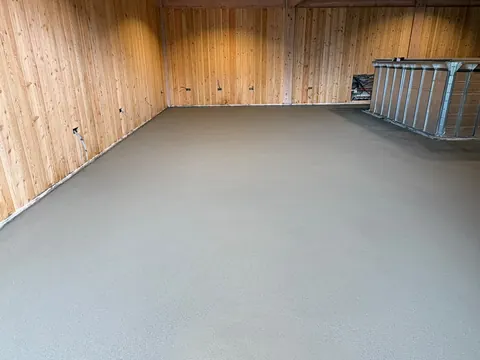
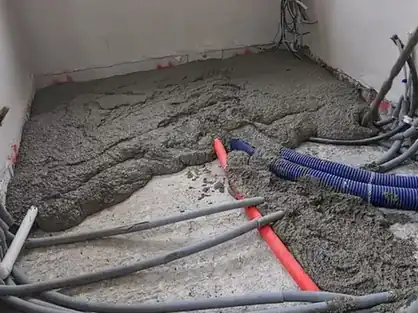
Calls on this site ring JAM Floor Screeding: James Mulhall, based in Portlaoise, 25 years laying floors. Lines open Mon to Sat, 7am to 6pm. These are his jobs.
“JAM were punctual, professional and efficient and did an outstanding job on pouring our new floor as part of a renovation. Very highly recommend!”
“Excellent work, laser level finish, neat and tidy worker, highly recommend.”
“Top class work by james and his crew, highly recommend”
Quoted word for word from JAM Floor Screeding's Google reviews. Read them on Google
Send the job in 4 quick taps
Tell us about the job. It goes to one screeding contractor who covers your county, and they ring you to price it from the drawings.
Floor Screeding guides & price breakdowns
Straight answers to what people ask most: itemised costs, specifications, planning or grants, and what to check before you book.
More guides & resources: All guides & calculator hub · Technical & trade glossary · Frequently asked questions · All areas covered · About this site
Screed specification questions
What thickness should a screed be under BS 8204?
For sand and cement: 25 mm bonded (40 specified), 50 mm unbonded (70 specified), 75 mm floating, 65 mm in housing.
What does CT-C20-F4 mean?
A cementitious (CT) screed with compressive strength class C20 (20 N/mm²) and flexural class F4 (4 N/mm²), under I.S. EN 13813.
What is SR2?
A surface regularity class in BS 8204: at most 5 mm under a 2 m straightedge. SR1 is 3 mm, SR3 10 mm.
Does a floating screed need mesh?
Floating sand and cement needs D49 mesh or fibres; calcium sulphate needs none. Put the choice in the specification.
Floor Screeding across all 26 counties
Requests from all 26 counties go to one vetted local specialist who covers your county — from Dublin, Cork, Galway and Limerick to Kildare, Meath, Wicklow, Waterford and Donegal. Pick your county below for local prices, specifications and advice. Compare all areas covered →
Send the job for a price
Four taps and your number. One screeding contractor who covers your county rings you and prices it from the drawings. Nothing is booked until you say yes.